Sourdough Starter Feeding Calculator
Pick a feeding ratio and how much starter you need, and see exactly what to keep, discard and feed.
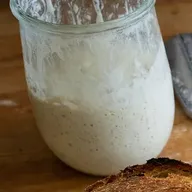
Your feed
Makes 220 g (7.8 oz) of starter: 200 g for your recipe and 20 g to keep.
- Ratio
- 1:5:5S : F : W
- Fed starter
- 220 g7.8 oz
- Hydration
- 100%after feeding
What the fed starter is made of, by weight.
- Ripe starter20%keep this much, discard the rest · ≈ 1 1/4 tbsp20 g0.71 oz
- Flour100%all-purpose, bread or part whole grain · ≈ 3/4 cup + 1 tbsp100 g3.5 oz
- Water100%lukewarm · ≈ 1/4 cup + 3 tbsp100 g3.5 oz
Add the weight of your starter jar contents under "Starter details" to see how much to discard.
| Ingredient | Weight | Baker's % |
|---|---|---|
| Fresh flour | 100 g | 100% |
| Fresh water | 100 g | 100% |
| Ripe starter | 20 g | 20% |
Percentages are of the fresh flour. Times to peak are what each source reported for its own starter, not a prediction for yours. Cups and spoons are approximate, based on King Arthur Baking's ingredient weights (all-purpose flour, 120 g per cup); a kitchen scale gives the best results.
How it works
A feeding ratio is written starter : flour : water by weight, so a 1:5:5 feed has 11 equal parts. The calculator adds up the starter you want to end with, divides it into parts, and gives one part to the old starter:
starter to keep = (starter needed + leftover) ÷ (1 + flour parts + water parts)
flour = starter to keep × flour parts, water = starter to keep × water parts
In "Just feeding" mode you enter the starter you keep and it simply multiplies. The hydration after feeding counts the flour and water already in the old starter, which is split as flour = starter ÷ (1 + hydration).
Worked example
- You need 200 g of ripe starter for a recipe and want 20 g left over: 220 g in all, fed 1:5:5.
- 1 + 5 + 5 = 11 parts, so one part is 220 ÷ 11 = 20 g of starter to keep.
- Flour = 20 × 5 = 100 g. Water = 20 × 5 = 100 g.
- Check: 20 + 100 + 100 = 220 g. Hydration = (10 + 100) ÷ (10 + 100) = 100%.
These numbers are Maurizio Leo's own routine from The Perfect Loaf: 20 g of ripe starter with 100 g of flour (70 g white, 30 g whole rye) and 100 g of water, fed every 12 hours in a 75–78 °F kitchen. The times to peak under the other ratios come from King Arthur Baking's 2025 feeding-ratio trial at 78 °F. Brød & Taylor's tests point the same way: 1:1:1 ripened in 4 to 5 hours, 1:8:8 needed about 10.
FAQ
What does a 1:5:5 feeding ratio mean?
It is starter : flour : water by weight. Keep 1 part ripe starter and add 5 parts flour and 5 parts water, so 20 g of starter gets 100 g of flour and 100 g of water. That is the feed Maurizio Leo of The Perfect Loaf gives his starter twice a day.
Which feeding ratio should I use?
Pick the one that peaks when you need it. In King Arthur Baking's trial at 78 °F, a 1:1:1 starter doubled in about 4 hours, 1:2:2 peaked after 8 hours and 1:4:4 after 12. A cool kitchen slows all of them, so use a smaller ratio there and a larger one when it is warm. King Arthur also found that the ratio made no difference to how the starter performed in the bread.
How much starter should I discard?
Everything except the ripe starter you keep for the feed. Enter what is in your jar under "Starter details" and the calculator shows the discard. You can bake with the discard instead of throwing it away.
Does the feeding ratio change my starter’s hydration?
Only if the flour and water parts differ. Equal parts keep a 100% starter at 100%. A 1:5:2.5 feed builds a stiff starter of about 55%, because only half as much water as flour goes in. The calculator shows the fed starter’s hydration, counting the flour and water already in the old starter.
How much starter do I need for one loaf?
Check your recipe. The Perfect Loaf's beginner's sourdough uses about 95 g of levain per loaf, and our sourdough calculator works it out for any loaf. Plan a little extra to keep back for the next feeding.
Related tools
 Sourdough Calculator
A sourdough bread recipe from loaf size, hydration and starter.
- Fermentation Time Calculator
Estimated rise time at your dough temperature.
- Desired Dough Temperature Calculator
The water temperature that hits your target dough temperature.
- Flour Cups to Grams
Cups to grams for every common flour type.